-
play_arrow
Newport City Radio – Live Right here, Right Now
-
 play_arrow
Which local legends are up for an award? Lamsie talks to Sam from GAVO

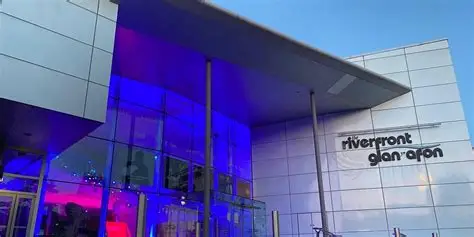
From the shadows to the Riverfront
There are few characters who have been brought from the shadows quite as many times as Count Dracula. More than a century after Bram Stoker first introduced him to the world, the vampire has been romanticised, sexualised, parodied and reinvented countless times. Finding something new to say about such a familiar figure is no easy task.
Going into James Hyland’s Dracula’s Guest, showing at the Riverfront on October 2nd, I had very little idea of what to expect.
Despite sharing its title with Bram Stoker’s posthumously published short story, Hyland’s play is not a straightforward adaptation of it. I deliberately went into the production almost entirely blind, and quickly discovered that its focus instead falls upon one of Dracula’s most intriguing characters: Renfield.
Written, produced and directed by Hyland, who also takes on the role of Dracula himself, Dracula’s Guest takes inspiration from the broken Renfield encountered in Stoker’s novel and imagines its own story surrounding his relationship with the Count.
Perhaps surprisingly, adapting Dracula was never Hyland’s original ambition. Speaking to me ahead of the performance, he explained that he felt Stoker’s novel had “already been successfully explored”. That changed during the pandemic, when a singular question occurred to him: “What if…?”
That question prompted what Hyland describes as “a flurry of notes” lasting the better part of a year.
At the centre of them was Renfield.
Hyland was “particularly interested in what brought Renfield to his degraded status as portrayed in the novel”, specifically his previous interactions with Dracula. Giving both characters a broader platform offered him an opportunity to explore aspects of their personalities and relationship which Stoker leaves largely unseen.
For somebody entering the theatre without knowing that premise, the decision makes for an intriguing discovery in itself. Ashton Spear’s Renfield is not simply the crazed familiar audiences might expect from popular depictions of Dracula. Here, he is an unwilling guest of the Count, already tortured physically and psychologically by the time we meet him. Spear throws himself into that torment, giving us a Renfield who is frightened, desperate and increasingly pushed to his limits.
Opposite him is Hyland’s Dracula: darkly charismatic, flamboyant and deeply manipulative.
“It was important for me to give Dracula his due,” Hyland told me, “to bring him out of the shadows and into the light.”
For Hyland, that meant finding a more human quality within the Count, creating someone the audience could recognise from everyday life despite the fantastical elements surrounding him.
Hyland’s Count certainly commands attention. He is flamboyant and imposing, with an undercurrent of dark humour that makes him an entertaining presence. But his charisma is also one of his most effective weapons. He can be amusing one moment and threatening the next, with charm, seduction and manipulation often bleeding into one another.
There is also an undeniable homoeroticism between Dracula and Renfield, although it is never quite as simple as attraction. Their relationship is wrapped up in manipulation and an uncomfortable imbalance of power, making it difficult to separate Dracula’s advances from the threat behind them.
Hyland described his approach to Stoker’s material as seeking a “stimulating yet economical theatrical presentation” which could foster greater empathy with its characters. Rather than attempting to recreate the sprawling Gothic grandeur traditionally associated with Dracula, the production trusts its performers to create much of its atmosphere themselves.
“Atmosphere often arises from what each character is focusing on in terms of their needs and how they go about fulfilling those needs,” Hyland explained. “The darker that focus is, the greater the tension, and thus the greater the horror.”
Dracula’s Guest puts that philosophy into practice. It doesn’t need an enormous Gothic castle looming in the background when so much of its unease is being created between the two men occupying the stage. In fact, all it needs is a table, a pair of chairs, and a bloody pig’s head.
The play’s interest in power also extends considerably beyond their immediate relationship. Themes of British colonialism and reparations increasingly come to the forefront. Questions of who invades, who exploits and what is ultimately owed sit alongside the more immediate struggle between captor and captive.
For Hyland, horror has always provided fertile ground for exactly these kinds of uncomfortable conversations.
“Strange as it may sound, horror offers great comfort,” Hyland told me, “as it frequently serves as a platform to explore the unspoken in everyday life.”
That philosophy is evident throughout Dracula’s Guest. For all its vampirism and Gothic grotesquery, its horror remains grounded in recognisably human behaviours. Dracula may be supernatural, but manipulation, cruelty, grief, and abuses of power certainly are not.
Writing, producing, directing and starring in the same production might sound like an exhausting amount of creative responsibility, but Hyland describes wearing all four hats as “creatively liberating”.
“They often bleed into each other,” he explained, “and serve to inform and inspire what I bring to each role.”
Hyland is also interested in more than simply making an audience afraid of his characters. He wants us to recognise something in them.
“I’m always excited for the audience to bear witness to the human qualities of these horror characters,” he said, “for in that process of discovery we may sometimes see ourselves.”
It is the human element that gives much of the production’s psychological horror its bite. The supernatural monster is safely fantastical. Manipulation, exploitation and abuses of power are considerably more familiar.
Perhaps going into Dracula’s Guest blind was ultimately the best way to experience it. Just when it seems the relationship between Dracula and Renfield has revealed its hand, the production has one final surprise in store.
To say much more would risk spoiling it, but the late twist casts what has come before in a different light and leads into an elaborate, blood-soaked climax. This is one worth experiencing with as little foreknowledge as possible.
And when I say bloody, I mean bloody.
When I asked Hyland about the biggest surprise involved in bringing the production together, his answer was considerably less philosophical than our earlier discussion: fake blood.
“I knew that a great deal would be needed,” he admitted, “but the actual amount is quite astronomical!”
Dracula’s Guest is definitely not for the faint of heart (or stomach!). Despite being a fan of horror and the macabre myself, even I found myself having to look away at points. The production does not shy away from the visceral or grotesque, with moments capable of provoking a genuine physical reaction. The horrified groans from the audience at certain pivotal points proved that.
There is something wonderfully contradictory about that excess appearing within such a minimalist production. The staging may be economical, but the performances, ideas and sheer quantity of blood certainly are not.
Hyland described his ambition as creating a drama that mirrors the human experience and reflects aspects of our nature, “both good and evil”, through “the prism of the twisted and the grotesque”.
If blood, gore and guts are your idea of a good night at the theatre, Dracula’s Guest will be right up your street. If not, you may want to to avert your eyes.
Written by Eve Astle
Written by: Ian Lamsdale
interview Newport review Riverfront
Post comments (0)