Crete is the largest of all the Greek islands. Its capital city is Heraklion, on the north coast. It has lots to offer tourists, with its numerous sandy beaches, long hot summers and mild winters — although snow is common on the mountains during winter.
Unlike some other parts of Greece, Crete is not home to any animals that are dangerous to humans. In fact, it is one of the few places in Europe where there are no native poisonous snakes.
Legend tells us that it was Heracles (also known by his Roman name, Hercules), famous for his strength and heroic adventures, who wanted to honour the birthplace of Zeus, king of the gods, by removing all harmful animals from Crete.
When Rob and I visited Crete, it was October, close to the end of the holiday season, and our resort was fairly quiet. However, Crete does get quite busy during peak holiday periods — and in recent years it has welcomed over 4 million tourists annually.
Many British holidaymakers head for the resort of Malia, famed for its nightlife, which rivals Ibiza and Magaluf. Malia attracts many big-name DJs in the summer months. A long, fine sandy beach and lots of restaurants and bars make it the resort that most young people choose when booking a lively holiday to Greece.
But it’s not all beaches, music and wild nights.
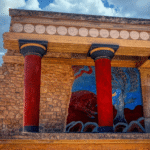
Crete is the place to visit if you’re a culture vulture. There are endless historical sites to see, and the island is rich in ancient Greek mythology. If you enjoy a bit of sightseeing, the Palace of Knossos is worth a visit.
This is where King Minos had the Labyrinth constructed to imprison the Minotaur, a half-man, half-bull creature, until it was slain by the Athenian hero Theseus.
As we usually do on holiday, Rob and I hired a car to go exploring. We had heard about Vai Forest, the largest natural palm tree forest in Europe. It was made famous in the 1970s by backpackers and briefly became a haven for the last of the hippie generation.
Today, with its attractive beach, Vai is a popular tourist destination and gets extremely busy. Luckily, since we were there so late in the year, we had no trouble parking or finding a space on the beach — but visitors should be prepared for crowds at peak times.
Although the island isn’t huge, it takes a long time to get around. Everywhere we wanted to go, there were mountains to cross. It wasn’t a problem for us — we were out to explore, and sitting in a car enjoying the scenery was fine by us.
I think it was when we were on our way to a place called Plakias, on the south coast, that we found ourselves lost in a small mountain village — small as in about half a dozen houses!
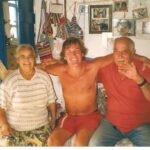
As we pulled over to the side of the road to study our map, an elderly Greek gentleman rushed over to assist us. He insisted on taking us to his humble home, across the road, for a glass of his homemade wine. He introduced us to his wife, Maria, and told us his name was Georgio. He spoke no English at all, and we spoke no Greek — yet somehow, we managed to have a conversation lasting a good half hour or so.
Georgio showed us around their home, which was actually just two rooms. The first, where we were sitting, contained a table, chairs, two single beds, and all their belongings. The second room was Georgio’s brewing room, filled with equipment for making wine and ouzo, along with dozens of bottles ready for sale. Of course, we bought some to take with us!
Maria’s cooking facilities were outside the main dwelling, in a sheltered corner of the garden, protected by the outer wall of the house and lots of shrubbery. She was keen for us to try her homemade feta cheese with salad. Then, she brought out some samples of her crochet work, and I found myself buying a scarf!
We signed their visitor’s book, and they showed us a box of letters and photos from people all over the world who had visited their home. Clearly, we weren’t the first tourists to get lost in the mountains!
Eventually, we left — with directions to where we wanted to go — and Maria and Georgio waved us off. What an odd but thoroughly enjoyable experience. We often talk about them, wondering if they ever made enough from their wine, cheese, and crochet sales to buy a Ferrari for zipping around the mountain roads!
We eventually reached the small fishing village of Plakias. Although it has become a tourist destination, it’s not bustling like some other places on Crete. At the end of a long sandy beach, there is an area used by nudists — though I hasten to add that wasn’t the reason we were looking for it! In fact, we didn’t even know there was a nudist beach there at the time!
During World War II, Plakias played a role in the resistance movements against the occupying Nazis.
Crete is a great place to visit — whether you’re after culture, parties, or just long, lazy days on a sunbed.
Kym Frederick
 play_arrow